Tableau Next Consulting
Agentic Analytics Inside Salesforce
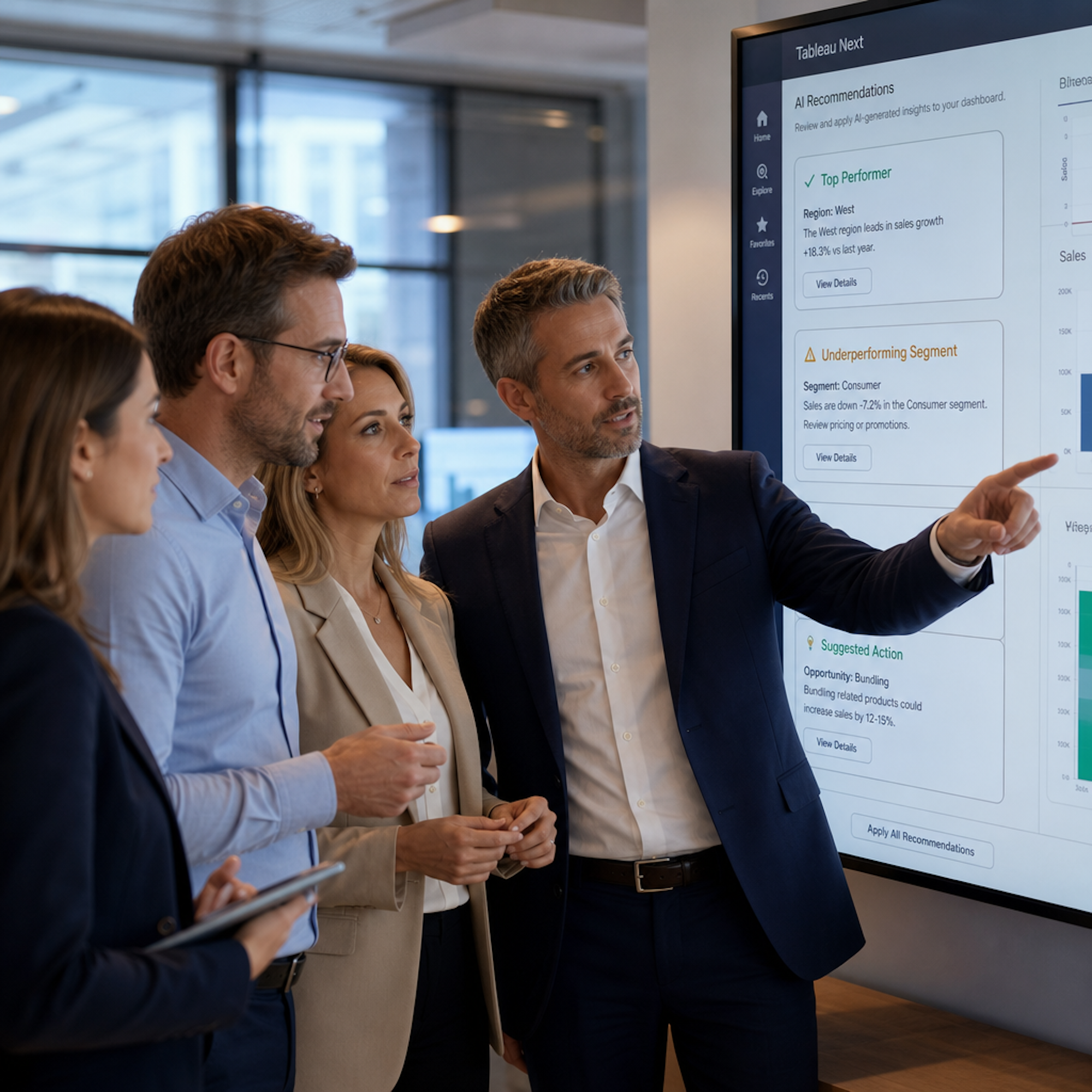
Tableau Next connects analytics, harmonised data, and AI agents directly within the Salesforce ecosystem. The platform is engineered for organisations seeking to bring analytics closer to daily workflows and translate data insights into immediate operational actions. The Information Lab guides clients through technical implementation, use case selection, and the long-term organisational integration of Tableau Next.
Where manual analysis slows decisions down
When a critical business question arises, manual coordination across emails, screenshots, and static spreadsheets stalls decision-making. Valuable time is lost and strategic execution is delayed, even though the required data already exists within the company.
As the next generation of Business Intelligence, Tableau Next eliminates friction between disparate tools and platforms. Teams can analyse complex data, uncover hidden relationships, and trigger operational workflows directly within Salesforce or Slack.
What Tableau Next does
Tableau Next combines harmonised business data from Data 360 with visual analytics and autonomous AI agents, closing the gap between insight and execution. Analytics no longer terminate at the dashboard interface; instead, findings trigger workflows directly within established Salesforce processes. Organisations can prioritise support cases, generate client communications, or advance sales opportunities in real time.

Working with The Information Lab
The Information Lab evaluates Tableau Next as an intelligent interplay between business data, semantic models, and operational processes. Our senior consultants unite expertise in AI engineering and data integration with deep BI and Salesforce capability. To ensure rapid adoption, we start with one use case that matters, and we set the data foundation and the permissions before any agent acts on it.
- Certified Partner Status
Official Tableau Next Alliance Partner and Tableau Next Implementation Partner. - Strategic Industry Influence
As members of the Salesforce Advisory Board, we contribute practical client experience directly to the development of next-generation analytics technologies. - Global Capacity
Access to over 600 data experts across our international network to support complex, enterprise-scale Tableau Next deployments.
How we implement Tableau Next
Deploying agentic analytics requires a structured, process-oriented methodology focused on clear business use cases while respecting existing Salesforce, analytics, and data environments.

Use Case Workshop
We evaluate business objectives, operational questions, and available data sources to prioritise high-value use cases and establish a realistic project scope.
Data Integration & Semantics
We connect relevant data sources and unify them within Data 360. Business logic and semantic layer structures are defined to provide a consistent foundation for analytics and AI agents.
Analytics & Agent Configuration
Visualisations, interactive dashboards, and AI agent actions are engineered and configured around prioritised operational workflows.
Enablement & Governance
We train internal teams, establish permission structures, and document technical and business logic. Additionally, we offer structured training formats to help teams master Tableau Next from the ground up.
Training & Team Enablement
Operating agentic analytics requires an understanding of how data pipelines, semantic models, interactive dashboards, and AI agents interact. The Information Lab provides role-based training programmes, regular webinars, and structured qualification formats. Training covers workspace setup, data integration, semantic modelling, dashboard development, and the daily application of AI-assisted analytics.
Expert Knowledge
Deploy Agentic Analytics in Your Organisation
Tell us which decision is currently too slow, and we will look at whether an agent can carry part of it. Contact our advisory team to evaluate your functional requirements, review technical prerequisites, and identify your highest-value use cases.

Jan Delventhal
Head of Business Development
Startseite- & Serviceskontakformular ENG
"*" indicates required fields
Frequently Asked Questions
How does Tableau Next differ from traditional Business Intelligence dashboards?
Traditional BI platforms end at data visualisation, requiring users to exit the dashboard to trigger actions manually within external systems (such as ERP or CRM). Tableau Next bridges this gap (Insight-to-Action). Through AI agents integrated directly into Salesforce and Slack, analytical insights immediately trigger automated operational workflows, such as reprioritising customer service tickets or launching targeted sales actions.
Is Salesforce Data Cloud mandatory for deploying Tableau Next?
Yes. Tableau Next requires Data 360 and the Data 360 semantic layer, so Data 360 is a technical prerequisite rather than an optional add-on. Where organisations do not yet run Data 360, we scope that step as part of the project and connect the existing source systems into it.
What is a semantic layer and why does it matter for AI agents?
For Artificial Intelligence to execute reliable actions, it must understand the exact business context of your data. A semantic layer translates raw database schemas into unambiguous business metrics and logic. This prevents AI agents from misinterpreting metrics and ensures the entire organisation operates on verified, single-source-of-truth definitions.
How do you stop agents from triggering unauthorised processes?
Deploying agentic analytics requires strict governance. The Information Lab establishes strict permission structures and documented operational logic. AI agents execute actions exclusively within clearly defined guardrails. Furthermore, we implement “Human-in-the-Loop” workflows, requiring human authorisation for critical operational actions prior to execution.
How should an organisation start with Tableau Next?
Successful implementation relies on a phased approach rather than a broad, immediate IT rollout. We recommend starting with a targeted Use Case Workshop to identify a specific, high-impact operational workflow (e.g. in customer service) where an agent can take over a step that is currently done by hand. Following successful deployment and user adoption, the platform can be scaled systematically.
What training is available?
Transitioning to agentic analytics transforms daily analytical workflows. To guarantee high user adoption, The Information Lab provides comprehensive team enablement. Alongside regular webinars and tailored in-house training, we offer structured learning pathways that guide teams step-by-step from workspace setup to the confident use of AI-assisted analytics.
