



Data & AI Consulting
Artificial Intelligence can accelerate data analysis, uncover hidden patterns, support predictive modeling and simplify data accessibility across the organisation. However, commercial ROI depends on whether data is structured cleanly, metrics are explicitly defined, and high-impact use cases are selected pragmatically.
The Information Lab supports enterprise organisations in evaluating and deploying Artificial Intelligence realistically within Business Intelligence, Data Analytics and Data Engineering environments. Our focus centers on applications that enhance data-driven decision-making, expand self-service analytics and seamlessly complement your existing data ecosystem.
Reliable AI
Begins with Engineered Data
Before Artificial Intelligence can deliver value within an organisation, fundamental prerequisites must be met. This requires available and clean data, unified metric definitions, explicit operational ownership and transparent mechanisms to audit results.
The Information Lab establishes the data foundation, semantic layers and governance guardrails necessary to make AI applications dependable. We apply the same engineering approach and attention to detail that has defined our successful BI, visual analytics and data engineering projects for over a decade.
Use Case Driven AI Advisory
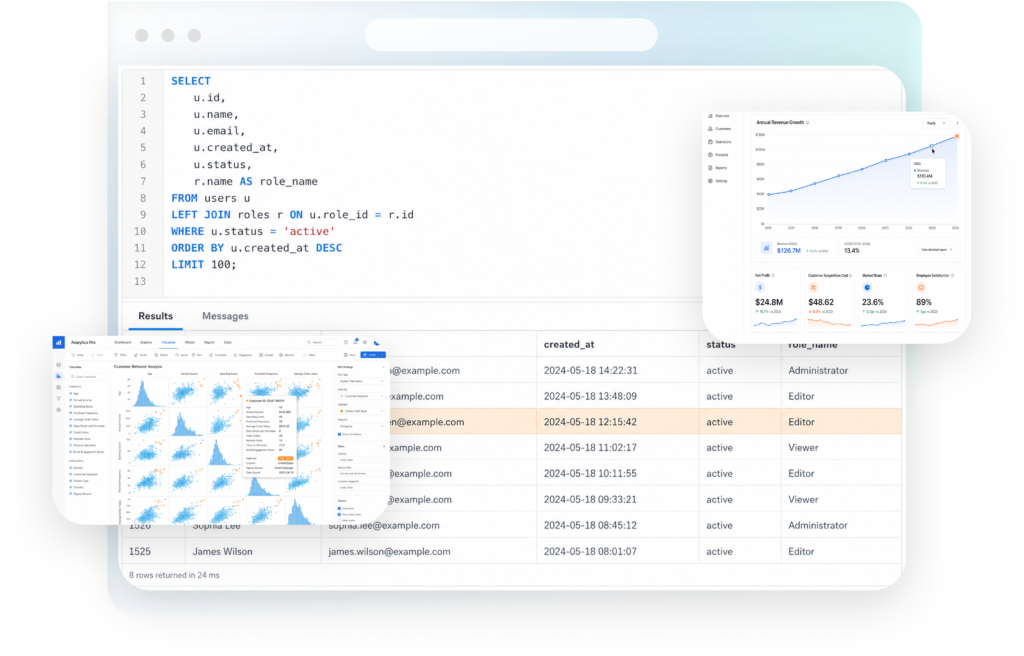
AI delivers value where it improves specific processes, supports decision-making or creates new opportunities for working with data. We therefore assess use cases based on their business value, the available data foundation, technical feasibility and long-term viability.
Key application areas include AI-assisted analytics, automated data preparation, predictive forecasting, data classification, anomaly detection, natural language interaction with business data and augmenting established BI workflows.
During scoping, we evaluate whether AI represents the optimal solution. In many operational scenarios, classic analytics methodologies, workflow automation, refactored data models, or clearer dashboard designs solve problems more efficiently than a complex Large Language Model. This objective evaluation forms a core element of our strategic advisory.
Core Pillars of
Our AI Advisory Practice


AI-Assisted Analytics
Across Modern Data Platforms




AI Governance, Security and Responsibility

Deploying AI applications requires strict operational guardrails, particularly when business-critical data, automated recommendations, or AI-generated insights inform executive decisions.
The Information Lab ensures Data Governance, information security and operational accountabilities are engineered into the architecture from day one. This encompasses role-based access controls, complete algorithmic transparency, calculation auditability, data quality testing and the responsible handling of AI outputs.
We implement AI where it operates reliably, controllably and with clear functional purpose. Validated use cases, performant data structures and a pragmatic understanding of technology capabilities form the foundation of our work.

Data & AI Expertise
The Information Lab unites deep AI expertise with an intimate understanding of enterprise data architectures, BI platforms, analytics workflows and company-wide enablement.
Our senior consultants operate across modern analytics and data engineering platforms, bringing real-world delivery experience to every project. We evaluate your prerequisites accurately, prioritise high-value use cases and implement solutions tailored strictly to your commercial goals.
As an official Tableau Next Alliance Partner and Implementation Partner, we bring early access and certified technical capability to next-generation agentic analytics and AI-driven decision processes.
Data & AI Enablement
Our specialised training programmes and webinars deliver practical technical knowledge, methodological safety and a clear understanding of how AI can enhance BI and analytics processes.
Take the Next Step Toward AI-Driven Analytics
Artificial Intelligence can transform how your organisation interacts with data, but it requires an audited technical foundation. An initial scoping session will evaluate your current data architecture, review potential use cases and outline a pragmatic roadmap for AI implementation.

Jens Chowdry
Head of Sales
Startseite- & Serviceskontakformular ENG
"*" indicates required fields
Frequently Asked Questions
Why is a clean data architecture a prerequisite for Artificial Intelligence?
Artificial Intelligence models are only as accurate as the underlying data fed into them. If source data contains schema errors, incomplete values, or ambiguous business definitions, advanced AI models inevitably produce unviable or distorted outputs (hallucinations). The initial step of any successful AI initiative is therefore engineering a clean, integrated, and audited data foundation (Data Engineering).
Is Artificial Intelligence always the right solution for analytics challenges?
Not necessarily. A primary aspect of our strategic advisory involves evaluating functional business challenges pragmatically. In many operational scenarios, classic Business Intelligence, dimensional data modeling, or automated dashboards resolve issues more cost-effectively and reliably than Large Language Models. The Information Lab integrates AI specifically where it enhances established BI workflows and delivers measurable ROI.
What does “Agentic Analytics” mean in modern BI ecosystems?
Agentic Analytics empowers business departments to query enterprise data using natural language and trigger automated analytical workflows. The Information Lab guides the technical and organisational implementation of these capabilities, utilising platforms such as Tableau Next, Tableau MCP, our proprietary TabCP Insight Agent, or Snowflake CoWork, to democratise data access securely.
How is information security guaranteed when deploying AI technologies?
Deploying AI requires stringent guardrails, particularly when processing business-critical data. As an ISO 27001 certified advisory partner, The Information Lab anchors Data Governance directly into the platform architecture from day one. Granular role-based access controls, transparent data pipelines and strict quality assertions ensure AI models operate securely, controllably and in full compliance with corporate policies.
What is AI Literacy and why is team enablement essential?
Deploying AI software alone does not guarantee organisational adoption. AI Literacy describes an company-wide capability to apply Artificial Intelligence critically, safely and effectively in daily operations. Through practical training programmes and executive workshops, we equip internal teams to interpret AI outputs accurately, recognise risks such as algorithmic bias and make data-driven decisions responsibly.
