



Tableau
Consulting
See, Understand, and Better Utilise Your Enterprise Data
Tableau is a leading platform for visual analytics and self-service BI within the Salesforce ecosystem. Organisations use Tableau to transform complex data into clear insights, build interactive dashboards, and accelerate data-backed decision-making. The Information Lab is a long-standing Tableau Premier Partner, Tableau Next Implementation Partner, and Tableau Next Alliance Partner. We provide comprehensive services across strategy, licensing, implementation, cloud migration, dedicated hosting, team enablement, and the ongoing optimization of existing Tableau environments.
Empowering Enterprise
Analytics with Tableau
Tableau makes analytics faster, more accessible, and fully interactive. Business units can explore ad-hoc questions independently, interact with dynamic dashboards, and translate insights directly into daily commercial decisions. Simultaneously, Tableau provides essential governance, security, and enterprise scaling capabilities.
User permissions, data sources, and published content can be managed systematically, ensuring that self-service BI fosters controlled, reliable analytics rather than uncoordinated report sprawl. When implemented correctly, Tableau serves as a cornerstone for modern data culture by aligning teams around unified KPIs, intuitive visualisations, and confident daily data usage.
Tableau as a Platform
As part of Salesforce, Tableau connects visual analytics, self-service BI, and AI-driven insights with a robust ecosystem for enterprise data, customer workflows, and corporate applications. The platform addresses core requirements across modern analytics environments, supporting data visualisation, visual data preparation, cloud deployment, governance, and collaborative analytics.

- Tableau Desktop
The primary application for creating interactive visualisations, performing deep-dive analyses, and designing enterprise dashboards. Connects seamlessly to disparate data sources to translate complex figures into clear insights. - Tableau Cloud
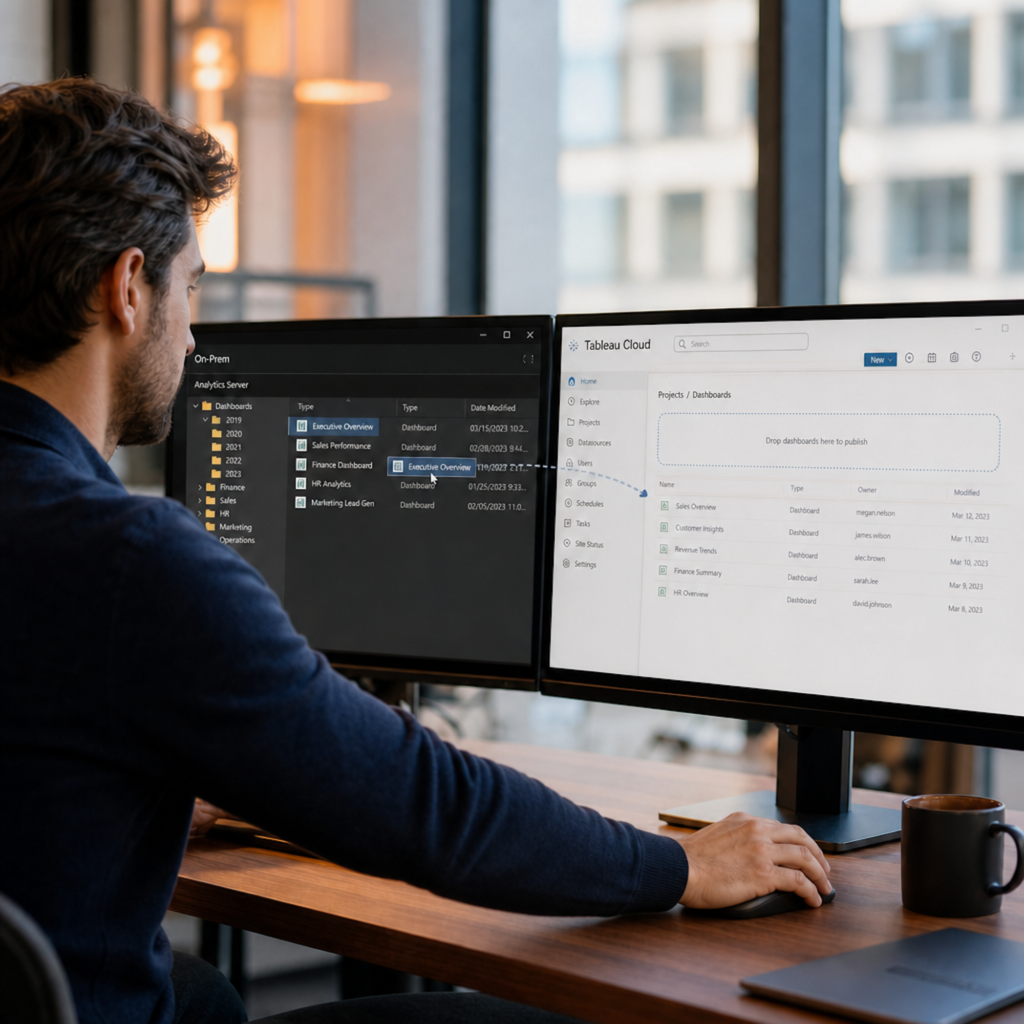
A fully managed, scalable SaaS environment for securely deploying, sharing, and governing dashboards across your organization—ensuring enterprise-wide access without infrastructure overhead. - Tableau Server
Offers self-managed deployment on-premise or within your private cloud. Designed for enterprise environments requiring full operational control, strict data sovereignty, and tailored compliance frameworks. - Tableau Next
Expands the ecosystem with agentic AI, a unified data layer, and semantic modeling within Salesforce—ideal for organizations embedding analytics directly into automated business workflows. - Tableau Prep
Simplifies visual data preparation. Clean, combine, combine, and structure complex data flows visually before feeding them into downstream analytics and reporting models. - Tableau Pulse
Delivers automated metric tracking and contextual insights directly to business users, enabling teams to detect critical trends proactive without manually hunting through dashboards. - Tableau Studio
Blends conversational AI with the traditional Tableau canvas. Generate initial visualizations, calculations, and layouts using natural language, then refine them using native Tableau authoring tools.
Scaling Your Tableau Capability with The Information Lab

Premier Partnership: Over a decade of experience guiding mid-market organisations and corporate groups through Tableau rollouts, platform migrations, and enterprise scaling.
Tableau Next Alliance: Certified expertise in deploying Tableau Next capabilities, agentic workflows, and high-impact AI use cases.
Certified Enterprise Expertise: Senior consultants backed by extensive technical certifications and real-world implementation experience.
Community & Visionary Leadership: Direct involvement in the global Tableau community ensures fresh methodologies and platform innovations inform every engagement.
Our Tableau
Service Portfolio



Advanced Tableau Solutions & Specialisations




Expert Knowledge
Optimise and Scale Your Tableau Platform
Whether launching a new deployment, migrating to Tableau Cloud, auditing licenses, or empowering internal teams, success requires a setup that aligns with your data architecture and delivers reliable daily value. Contact our advisory team to discuss your status quo and outline a pragmatic path forward.

Jan Delventhal
Head of Business Development
Startseite- & Serviceskontakformular ENG
"*" indicates required fields
Frequently Asked Questions
When is migrating to Tableau Cloud recommended over dedicated Tableau Server hosting?
The decision depends primarily on internal compliance regulations, data sovereignty policies, and existing IT infrastructure. Tableau Cloud significantly reduces administrative overhead and scales automatically. For heavily regulated sectors or organisations with highly specific security demands, dedicated Tableau Server hosting—such as within a secure AWS environment—remains a preferred choice. The Information Lab manages end-to-end architecture design and migration for both pathways.
How do you prevent dashboard sprawl and maintain data quality in self-service environments?
Successful self-service analytics requires clear operational guardrails. The Information Lab establishes robust governance frameworks, including granular permission structures, certified data models (Single Source of Truth), and structured content publishing workflows. This grants business units the flexibility to explore data independently while IT retains control over data quality and system performance.
Does The Information Lab assist in optimizing Tableau license costs?
Yes. A tailored license structure is vital for commercial efficiency and user adoption. Our advisory includes an in-depth usage audit to determine the optimal balance of Creator, Explorer, and Viewer licenses, ensuring you pay only for the operational capabilities your organisation actively requires.
Can sluggish, low-performing Tableau dashboards be optimized?
Yes. Query performance issues in Tableau rarely stem from the software itself, but rather from inefficient data models, unoptimized underlying database queries, or sub-optimal calculated fields. Our consultants audit legacy workbooks and data sources, refactoring calculations and data flows to restore fast, reliable dashboard rendering.
What commercial value does Tableau Next bring to enterprise analytics?
Tableau Next and technologies like the Model Context Protocol (MCP) bridge classic dashboards with agentic, AI-driven analytics. Users can query complex data using natural language to extract contextual insights rapidly. As an official Tableau Next Implementation Partner, we help integrate these AI capabilities securely into established business processes to deliver measurable value.
Can Tableau integrate seamlessly with cloud data platforms?
Tableau functions as a high-performance visual frontend within modern Best-of-Breed architectures. It features native, highly optimized connectors to leading cloud platforms such as Snowflake, Databricks, and AWS. Our team ensures upstream data transformation—managed via dbt or Alteryx—aligns perfectly with the visual analytics layer.
