

Data Architecture
Consulting
Scalable Structures for Modern Data Management
The Information Lab supports organisations in designing, modernising and expanding their data architecture. We evaluate the entire Data Value Chain, building resilient structures aligned with your existing IT landscape, corporate data strategy and specific operational demands.
Designing Infrastructure
for Sustainable Data Growth
As new software platforms, source systems, and departmental reports are introduced, the complexity of your company-wide data landscape increases exponentially. Lacking an overarching architecture framework, organisations quickly develop isolated systems, conflicting metric definitions, and unreliable data pipelines. Executive dashboards suffer severe query latency, and integrating new business requirements becomes disproportionately complex and expensive.
A resilient data architecture restores structural clarity. It integrates disparate systems and source data, structures automated data flows and delivers high-quality information wherever it is required for analytics, strategic decision-making, and daily operational processes.
Engineering Across the Data Value Chain
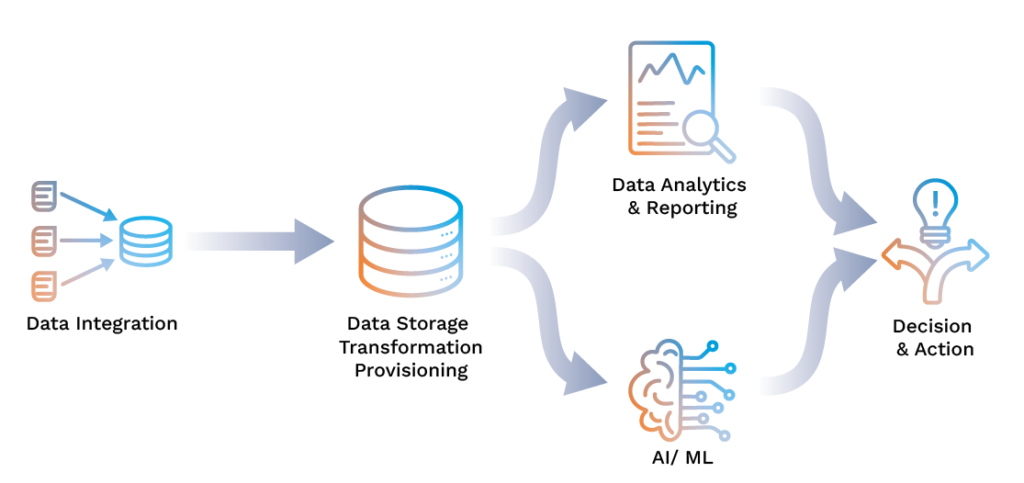
Building a dependable data landscape requires an end-to-end perspective on how data is ingested, processed, secured and delivered. This encompasses connecting source systems, establishing scalable storage layers within Data Warehouses or Data Lakehouses, executing automated transformations and data modeling, and provisioning clean access layers for Business Intelligence, visual analytics, and Artificial Intelligence. These architectural pillars must interlock seamlessly to ensure daily operational stability.
Key Attributes
of a Performant Architecture
A modern data architecture unifies data across the organisation in a controlled, consistent and traceable manner. To achieve this, data ingestion, storage, and transformation must be engineered as an integrated process. Data Warehouses, Lakehouses, or hybrid data platforms must scale linearly alongside rising data volumes, new source systems, and expanding use cases without compromising query performance or maintainability.
By embedding transparent data modeling, version-controlled transformations, and automated quality checks from day one, we eliminate retrofitted security risks. This creates a secure foundation for executive reporting, dashboards, self-service BI, and AI applications, ensuring queries remain performant and new analytical use cases integrate cleanly into your existing ecosystem.

Your Data Architecture mit The Information Lab
The Information Lab designs data architectures driven by operational application. A technical data structure must not only function quietly in the backend; it must make data across the organisation faster, clearer and more dependable for the people who rely on it daily.
Our deep delivery background across Data Engineering, Business Intelligence, analytics, and data visualisation directly shapes our architectural design. Consequently, we understand the technical engineering requirements of backend data pipelines as intimately as the operational demands of business units, analysts and executive leadership.
We bridge strategic positioning with technical execution, delivering data structures that are technically resilient, and directly support your core commercial objectives.
Our Services






Implementation Framework
Building a sustainable data architecture begins with an objective understanding of your existing IT ecosystem and operational requirements. Based on these insights, we engineer a realistic target blueprint and convert it into prioritised implementation milestones. Technology selection, security protocols, system operations, and end-user adoption are evaluated together from the outset.

Assess Status Quo
We evaluate existing source systems, databases, manual workflows, executive reports, user groups, and operational bottlenecks.
Design Target Architecture
Based on functional and technical needs, we define a clear target blueprint for data integration, storage, transformation, governance, and analytics access.
Define Roadmap & Priorities
We convert the target blueprint into an actionable roadmap, prioritising technical dependencies, architecture decisions, and resource allocation.
Implement Architecture
Our senior consultants and data engineers build the platform environment, automated pipelines, data models, testing suites, and BI connectors.
Secure Operations & Enablement
Standards, technical documentation, and hands-on team enablement ensure your internal teams operate, maintain, and adapt the architecture long-term.
Technology Stack Aligned with Your Architecture
The Information Lab operates strictly tool-agnostically. Technology selection is governed exclusively by your requirements regarding query performance, linear scalability, information security, regulatory compliance, operational complexity, and budget parameters.
Depending on your baseline, we implement cloud platforms like Snowflake, Databricks, AWS, or Microsoft Fabric, paired with modern ingestion and transformation tools such as dbt, Fivetran, or Alteryx. Existing on-premise and legacy enterprise systems can also be integrated cleanly into hybrid setups.
The key lies in the seamless interplay between components. We engineer data architectures to fit your current technical reality while supporting new business demands and long-term expansion.






Project Delivery via
Managed Data Teams
When internal engineering teams require specialised technical knowledge or extra delivery capacity, our flexible engagement models provide immediate, high-impact reinforcement. Our teams connect source systems, design dimensional data models, engineer ELT pipelines and integrate automated quality testing by accelerating your data warehouse initiatives without requiring full operational outsourcing.




Trust Through Experience & ISO Certification
The Information Lab brings over a decade of experience delivering Business Intelligence, analytics, data engineering, and visual analytics projects across Europe. Our consultants hold advanced vendor certifications across leading cloud and data technologies.
As a tool-agnostic partner, we evaluate the entire data value chain rather than pushing isolated software licenses. Furthermore, our ISO 27001 certification guarantees information security, audited processes, and strict compliance standards. Independent client reviews on ProvenExpert reflect our execution quality, where over 900 client testimonials maintain an average rating of 4.8 out of 5 stars.
Training & Webinare
A data architecture remains sustainable over the long term only when internal engineering and analytics teams understand its design logic and operate it with confidence. Our training formats deliver practical, role-based instruction covering data integration, data warehousing, transformation logic, quality assurance, and modern cloud platform administration.
Insights
Knowledge Shared by Our Team
Modernise Your Enterprise Data Architecture
Whether resolving performance bottlenecks in a historically grown landscape, migrating to a modern cloud data platform, or preparing your infrastructure for AI analytics: let us evaluate your status quo in an initial consultation and define the optimal path forward.

Benjamin Schalk
Head of Consulting
Startseite- & Serviceskontakformular ENG
"*" indicates required fields
Frequently Asked Questions
What is the difference between Data Strategy and Data Architecture?
While a Data Strategy defines overarching corporate goals, business processes, governance policies, and investment priorities, Data Architecture provides the technical and structural foundation. It maps and engineers the physical Data Value Chain, from source system integration and storage within a Data Warehouse or Lakehouse to automated data transformation for BI and analytics applications.
How do organisations recognise that their data architecture is outdated?
Common symptoms of an overstretched data architecture include severely lagging dashboard response times, conflicting performance figures across departments, and opaque data silos. When business departments spend more time manually exporting, searching, and cleaning data in spreadsheets than conducting analysis, technical architecture modernisation is urgently required.
Why is a modern data architecture a prerequisite for Artificial Intelligence?
AI applications, Machine Learning models, and agentic analytics require a structured, clean, and highly available data foundation. A modern, AI-ready data architecture ensures models are fed continuously and securely with high-quality corporate data. Without this clean backend foundation, even advanced AI interfaces will fail to generate reliable business value.
Are your data architecture concepts tied to specific software vendors?
No. Advisory delivered by The Information Lab is strictly tool-agnostic. Your architecture setup is determined entirely by your operational use cases, IT security policies, and existing technology landscape. Our data engineering team brings certified expertise across leading cloud and data platforms, including Snowflake, Databricks, dbt, Alteryx, Tableau, AWS, and Microsoft Power BI.
How does a typical data architecture project proceed?
Engagements do not begin with a massive, disruptive IT overhaul, but with a focused Architecture Assessment. We isolate immediate query bottlenecks and outline a pragmatic transformation roadmap. Our data engineers then implement robust ELT/ELT pipelines alongside structured team enablement, ensuring your internal IT and data teams can operate, maintain, and expand the architecture independently over the long term.
Which regions are covered by your data architecture consulting services?
From our headquarters in Hamburg, our certified consultants design and implement modern data landscapes for corporate groups and mid-market companies across Germany, Austria, and Switzerland (DACH). As an ISO 27001certified partner, The Information Lab guarantees strict information security protocols and total confidentiality when engineering business-critical infrastructure.
